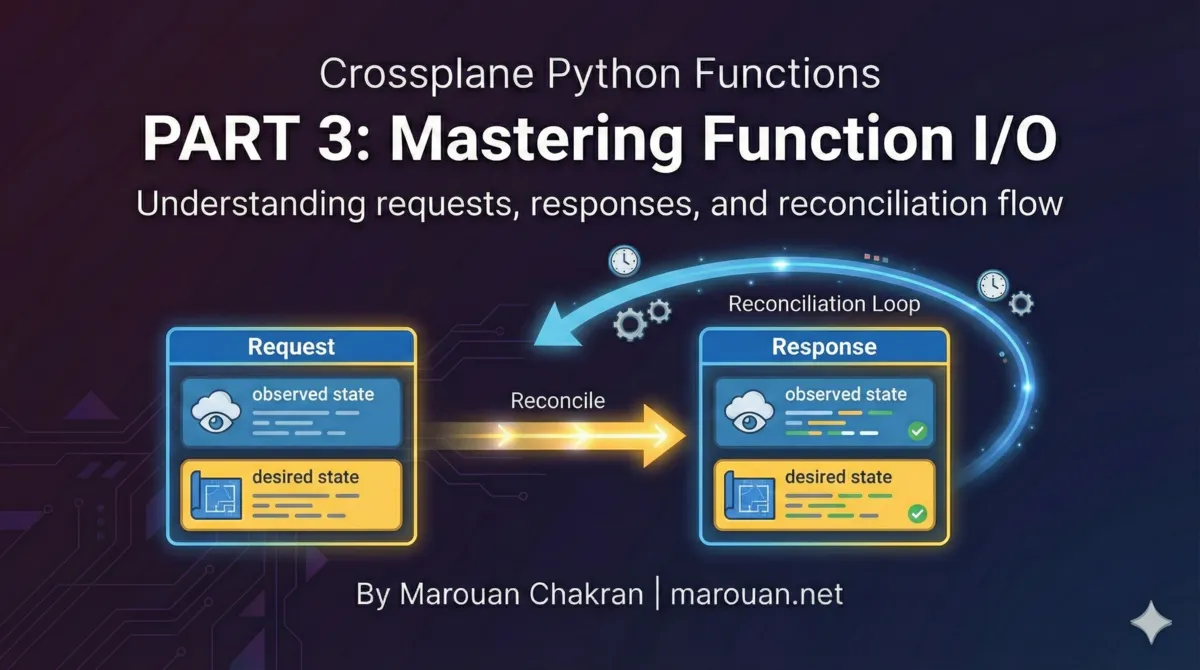
Understanding Composition Function I/O
Crossplane Python Functions | Part 3
Building a production multi-cloud platform with Python
In Part 2, we built a working function but treated the request and response as black boxes. To build sophisticated compositions, you need to understand exactly what data flows through your function.
This post dissects RunFunctionRequest and RunFunctionResponse, shows how to convert protobuf structures to Python dicts, and introduces a type-safe Composition class that simplifies working with these structures.
The RunFunctionRequest
Every function invocation receives a RunFunctionRequest. This protobuf message contains everything your function needs to make decisions.
Request Structure
message RunFunctionRequest {
  RequestMeta meta = 1;
  State observed = 2;
  State desired = 3;
  google.protobuf.Struct input = 4;
  google.protobuf.Struct context = 5;
  repeated Credentials credentials = 6;
}
Let's examine each field:
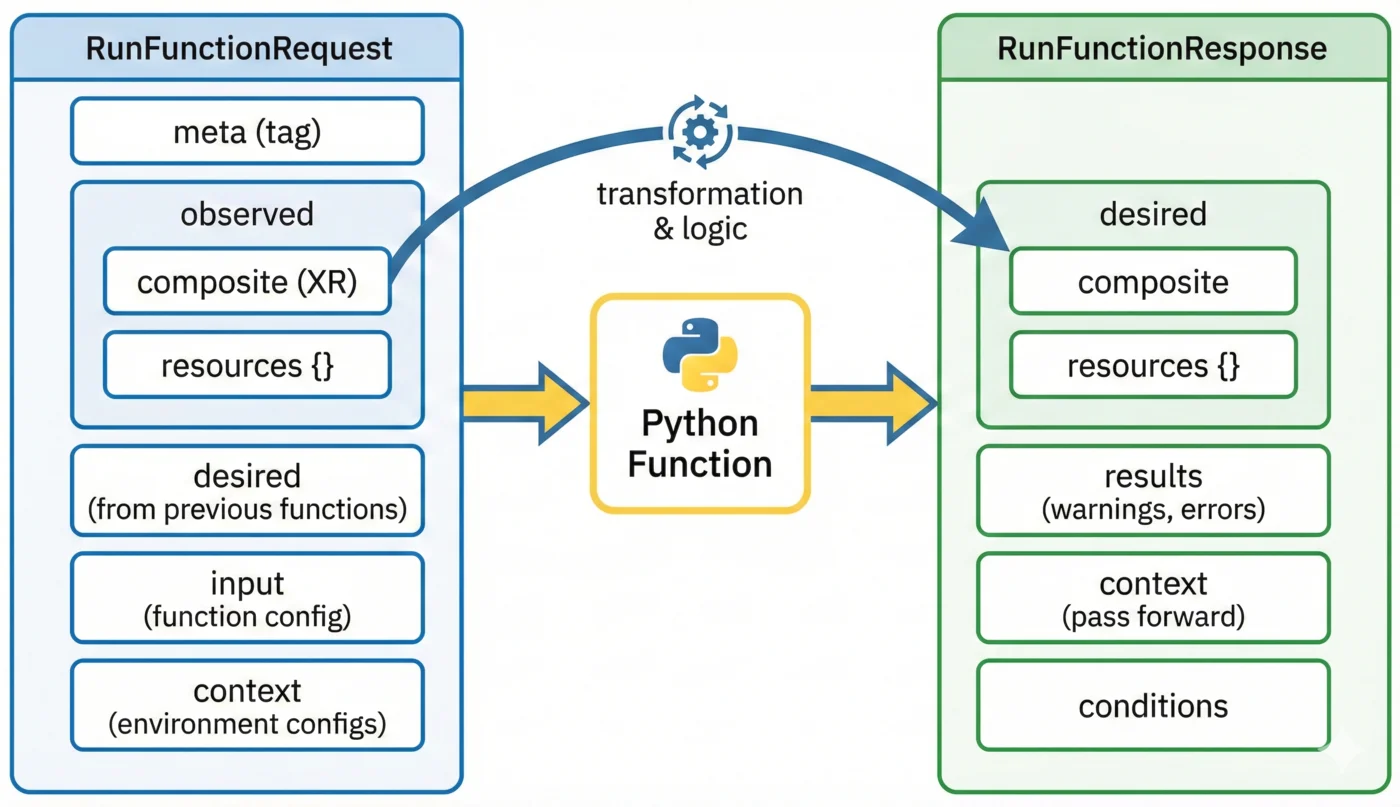
1. meta: Request Metadata
req.meta.tag # Unique identifier for this request
The tag is useful for logging and debugging—it identifies the specific reconciliation.
2. observed: Current Cluster State
This is what actually exists:
# The composite resource (XR) as it exists in the cluster
req.observed.composite.resource

# Managed resources created by previous reconciliations
req.observed.resources  # Dict[str, ObservedResource]
The observed state includes:
- composite: The XR with its current spec and status
- resources: Managed resources keyed by their composition resource name
Each observed resource contains:
observed_bucket = req.observed.resources["bucket"]
observed_bucket.resource       # The full resource as a Struct
observed_bucket.connection_details  # Connection secrets
3. desired: What Previous Functions Requested
In a pipeline with multiple functions, each function receives what previous functions requested:
# Resources from earlier pipeline steps
req.desired.composite.resource
req.desired.resources  # Dict[str, DesiredResource]
Your function should preserve or modify this state, not replace it entirely.
4. input: Function Configuration
Configuration passed to your function in the composition:
pipeline:
  - step: my-function
    functionRef:
      name: function-myplatform
    input:
      apiVersion: myplatform.io/v1alpha1
      kind: Input
      module: cluster
      debug: true
Access in Python:
input_dict = MessageToDict(req.input)
module = input_dict.get("module", "default")
debug = input_dict.get("debug", False)
5. context: Environment and Extra Data
Environment configs and data from previous functions:
# Environment configs merged by label selectors
env = req.context["apiextensions.crossplane.io/environment"]

# Custom context from previous functions
custom_data = req.context.get("my-custom-key", {})
Environment configs are powerful—we'll cover them in Part 6.
The RunFunctionResponse
Your function returns a RunFunctionResponse describing what should exist.
Response Structure
message RunFunctionResponse {
  ResponseMeta meta = 1;
  State desired = 2;
  repeated Result results = 3;
  google.protobuf.Struct context = 4;
  repeated Requirement requirements = 5;
  repeated Condition conditions = 6;
}
1. desired: Resources You Want
The most important field—what resources should exist:
# Set desired composite resource
rsp.desired.composite.resource.CopyFrom(xr_struct)

# Add a managed resource
rsp.desired.resources["bucket"].resource.CopyFrom(bucket_struct)

# Mark a resource as ready
rsp.desired.resources["bucket"].ready = (
    fnv1.Ready.READY_TRUE
)
2. results: Feedback Messages
Report status, warnings, or errors:
from crossplane.function import response

# Info message
response.normal(rsp, "Created 3 buckets")

# Warning
response.warning(rsp, "Deprecated parameter 'oldName' used")

# Fatal error (stops reconciliation)
response.fatal(rsp, "Missing required label 'cloud'")
3. context: Pass Data Forward
Share data with subsequent functions:
context_struct = struct_pb2.Struct()
context_struct.fields["cluster_endpoint"].string_value = endpoint
rsp.context.CopyFrom(context_struct)
4. conditions: XR Status Conditions
Set conditions on the composite resource:
rsp.conditions.append(fnv1.Condition(
    type="DatabaseReady",
    status=fnv1.Status.STATUS_CONDITION_TRUE,
    reason="Available",
    message="Database is accepting connections",
))
Protobuf to Python Dict Conversion
Working with raw protobuf is tedious. Convert to Python dicts for easier manipulation.
Using MessageToDict
from google.protobuf.json_format import MessageToDict

# Convert the XR to a dict
xr = req.observed.composite.resource
xr_dict = MessageToDict(xr)

# Now you can use normal Python operations
bucket_name = xr_dict["spec"]["parameters"]["bucketName"]
labels = xr_dict["metadata"]["labels"]
Converting Back to Protobuf
Use google.protobuf.struct_pb2.Struct:
from google.protobuf import struct_pb2
from google.protobuf.json_format import ParseDict

# Method 1: ParseDict
bucket_dict = {"apiVersion": "s3.aws...", "kind": "Bucket", ...}
bucket_struct = struct_pb2.Struct()
ParseDict(bucket_dict, bucket_struct)

# Method 2: Manual conversion (more control)
def dict_to_struct(d: dict, struct: struct_pb2.Struct) -> None:
    """Recursively convert a dict to a protobuf Struct."""
    for key, value in d.items():
        if isinstance(value, dict):
            dict_to_struct(value, struct.fields[key].struct_value)
        elif isinstance(value, list):
            list_value = struct.fields[key].list_value
            for item in value:
                if isinstance(item, dict):
                    dict_to_struct(item, list_value.values.add().struct_value)
                elif isinstance(item, bool):
                    list_value.values.add().bool_value = item
                elif isinstance(item, (int, float)):
                    list_value.values.add().number_value = item
                else:
                    list_value.values.add().string_value = str(item)
        elif isinstance(value, bool):
            struct.fields[key].bool_value = value
        elif isinstance(value, (int, float)):
            struct.fields[key].number_value = value
        elif value is None:
            struct.fields[key].null_value = 0
        else:
            struct.fields[key].string_value = str(value)
Common Gotchas
Booleans before numbers: Python's isinstance(True, int) returns True, so check for bool before int/float.
Empty dicts: An empty dict {} needs explicit handling—don't skip it.
None values: Protobuf has NullValue, not Python's None.
Building a Type-Safe Composition Class
Managing raw requests and responses is error-prone. Wrap them in a class.
The Composition Dataclass
from dataclasses import dataclass
from crossplane.function.proto.v1 import run_function_pb2 as fnv1
from google.protobuf.json_format import MessageToDict
from pydash import get, merge
from structlog.stdlib import BoundLogger

@dataclass
class Composition:
    """Wraps function request/response with convenient accessors."""

    req: fnv1.RunFunctionRequest
    rsp: fnv1.RunFunctionResponse
    log: BoundLogger

    def __post_init__(self):
        """Initialize computed properties."""
        self.observed = self.req.observed
        self.desired = self.rsp.desired

        # The composite resource
        self.xr = self.observed.composite.resource

        # Common metadata fields
        self.metadata = dict(self.xr.get("metadata", {}))
        self.labels = self.metadata.get("labels", {})
        self.annotations = self.metadata.get("annotations", {})
        self.name = self.metadata.get("name", "")

        # Cloud provider from label
        self.cloud = self.labels.get("cloud", "gcp")

        # Spec fields
        self.spec = dict(self.xr.get("spec", {}))
        self.params = MessageToDict(self.spec.get("parameters", {}))
        self.for_provider = MessageToDict(self.spec.get("forProvider", {}))

        # Environment configs
        env_key = "apiextensions.crossplane.io/environment"
        self.env = MessageToDict(self.req.context.get(env_key, {}))

        # Merge environment with XR labels and params for templates
        self.env = merge(
            self.env,
            self.labels,
            self.params,
        )

        # Location/region (varies by cloud)
        self.location = (
            get(self.for_provider, "location")
            or get(self.for_provider, "region")
            or get(self.env, "location")
            or get(self.env, "region")
        )

    def get_observed(self, name: str) -> dict | None:
        """Get an observed resource by name."""
        if name not in self.observed.resources:
            return None
        return MessageToDict(self.observed.resources[name].resource)

    def get_observed_status(self, name: str, field: str) -> any:
        """Get a field from an observed resource's status."""
        resource = self.get_observed(name)
        if not resource:
            return None
        return get(resource, f"status.atProvider.{field}")

    def is_ready(self, name: str) -> bool:
        """Check if an observed resource is ready."""
        if name not in self.observed.resources:
            return False
        conditions = self.get_observed(name).get("status", {}).get("conditions", [])
        for condition in conditions:
            if condition.get("type") == "Ready":
                return condition.get("status") == "True"
        return False
Using the Composition Class
Now your function logic becomes clean:
def RunFunction(self, req, context):
    rsp = response.to(req)
    c = Composition(req=req, rsp=rsp, log=self.log)

    # Clean access to common fields
    c.log.info("Processing", cloud=c.cloud, name=c.name)

    # Access parameters naturally
    bucket_name = c.params.get("bucketName", f"{c.name}-bucket")
    region = c.location

    # Check if a resource exists
    existing = c.get_observed("bucket")
    if existing:
        endpoint = c.get_observed_status("bucket", "endpoint")

    # Cloud-specific logic
    if c.cloud == "gcp":
        add_gcs_bucket(c, bucket_name, region)
    elif c.cloud == "aws":
        add_s3_bucket(c, bucket_name, region)

    return rsp
Extending for Your Use Case
Add properties for your domain:
@dataclass
class ClusterComposition(Composition):
    """Composition for Kubernetes clusters."""

    def __post_init__(self):
        super().__post_init__()

        # Cluster-specific fields
        self.cluster_name = self.labels.get("clusterName", self.name)
        self.pools = self.params.get("pools", {})
        self.domain = self.params.get("domain", "")

        # Networking
        self.network = self.env.get("network", {})
        self.subnet_cidr = self.network.get("subnetCidr", "10.0.0.0/24")

    @property
    def is_private(self) -> bool:
        """Whether this is a private cluster."""
        return self.params.get("privateCluster", True)

    @property
    def enable_dns(self) -> bool:
        """Whether to create DNS zones."""
        return bool(self.domain) and self.params.get("createDnsZones", True)
Accessing Observed State
Observed state is crucial for:
- Conditional logic: Create resource B only after A is ready
- Referencing outputs: Use cluster endpoint in Helm values
- Import workflows: Check if resources exist before managing
Checking Resource Existence
def cluster_exists(c: Composition) -> bool:
    """Check if cluster is created and ready."""
    cluster = c.get_observed("cluster")
    if not cluster:
        return False
    return c.is_ready("cluster")
Getting Resource Outputs
def get_cluster_endpoint(c: Composition) -> str | None:
    """Get the cluster's API endpoint from observed state."""
    return c.get_observed_status("cluster", "endpoint")
Conditional Resource Creation
def add_helm_releases(c: Composition):
    """Add Helm releases only after cluster is ready."""
    if not cluster_exists(c):
        c.log.info("Waiting for cluster before adding Helm releases")
        return

    endpoint = get_cluster_endpoint(c)
    if not endpoint:
        c.log.warning("Cluster ready but no endpoint found")
        return

    add_cert_manager(c)
    add_ingress_nginx(c)
Navigating Environment Configs
Environment configs provide defaults and overrides:
# Get with fallback
machine_type = c.env.get("defaultMachineType", "e2-medium")

# Nested access with pydash
from pydash import get

monitoring_enabled = get(c.env, "monitoring.enabled", True)
prometheus_retention = get(c.env, "monitoring.prometheus.retention", "30d")
We'll cover environment configs in depth in Part 6.
Complete Example
Here's a function using the Composition class:
from dataclasses import dataclass
from crossplane.function import logging, response
from crossplane.function.proto.v1 import run_function_pb2 as fnv1
from crossplane.function.proto.v1.run_function_pb2_grpc import FunctionRunnerServiceServicer

class FunctionRunner(FunctionRunnerServiceServicer):
    def __init__(self):
        self.log = logging.get_logger()

    def RunFunction(self, req, context):
        rsp = response.to(req)
        c = Composition(req=req, rsp=rsp, log=self.log.bind(tag=req.meta.tag))

        try:
            self.create_resources(c)
        except Exception as e:
            c.log.error("Function failed", error=str(e))
            response.fatal(rsp, f"Function error: {e}")

        return rsp

    def create_resources(self, c: Composition):
        c.log.info("Creating resources", cloud=c.cloud, name=c.name)

        # Validate required fields
        if not c.cloud:
            response.fatal(c.rsp, "Missing required label: cloud")
            return

        # Create cloud-specific resources
        if c.cloud == "gcp":
            self.create_gcp_resources(c)
        elif c.cloud == "aws":
            self.create_aws_resources(c)
        elif c.cloud == "azure":
            self.create_azure_resources(c)
        else:
            response.fatal(c.rsp, f"Unsupported cloud: {c.cloud}")

    def create_gcp_resources(self, c: Composition):
        # GCP-specific implementation
        pass

    def create_aws_resources(self, c: Composition):
        # AWS-specific implementation
        pass

    def create_azure_resources(self, c: Composition):
        # Azure-specific implementation
        pass
Key Takeaways
RunFunctionRequestcontains observed state, desired state from previous functions, input config, and environment contextRunFunctionResponsespecifies what resources should exist and reports results- Use
MessageToDictto convert protobuf to Python dicts for easier manipulation - Wrap in a Composition class for type safety and clean access to common fields
- Observed state lets you create resources conditionally based on what exists
Next Up
In Part 4, we introduce the 3-layer resource pattern—the architecture that makes multi-cloud compositions maintainable. You'll learn how to write one function call that produces the correct resources for GCP, AWS, or Azure.
Written by Marouan Chakran, Senior SRE and Platform Engineer, building multi-cloud platforms with Crossplane and Python.
Part 3 of 10 | Previous: Your First Python Function | Next: The 3-Layer Resource Pattern
Companion repository: github.com/Marouan-chak/crossplane-python-blog-series
Tags: crossplane, platform-engineering, kubernetes, python, devops